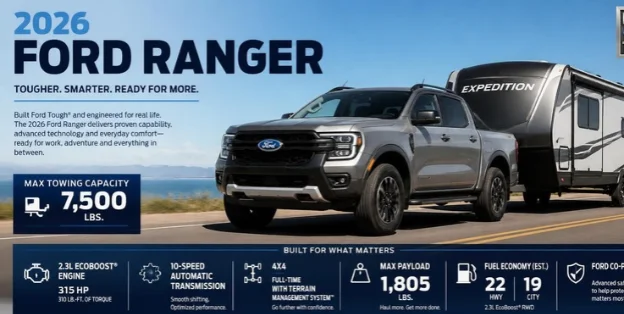
The Ford Ranger towing capacity reaches 7,500 pounds for properly equipped 2026 XL, XLT, and Lariat models. The Ranger Raptor has a lower 5,510-pound maximum despite its more powerful engine. Your usable limit can also fall once passengers, cargo, accessories, and trailer tongue weight enter the calculation.
Ford requires the available Trailer Tow Package for the highest conventional towing rating. A Ranger towing only from its rear step bumper is limited to 3,500 pounds. That difference makes the truck’s equipment almost as important as its engine.
Quick answer: A properly equipped 2026 Ranger XL, XLT, or Lariat can tow up to 7,500 pounds. The Raptor tops out at 5,510 pounds. Ford also limits bumper-only towing to 3,500 pounds, so reaching the maximum rating requires the correct hitch and factory towing equipment.
| 2026 Ranger configuration | Maximum trailer weight | Key requirement |
|---|---|---|
| 2.3L EcoBoost, 4×2 | 7,500 lb | Trailer Tow Package |
| 2.3L EcoBoost, 4×4 | 7,500 lb | Trailer Tow Package |
| 2.7L EcoBoost V6, 4×4 | 7,500 lb | Trailer Tow Package |
| 3.0L EcoBoost V6 Raptor | 5,510 lb | Tow equipment standard |
| Rear step bumper only | 3,500 lb | 350-lb maximum tongue load |
| Hitch receiver, non-Raptor | 7,500 lb | 750-lb maximum tongue load |
| Hitch receiver, Raptor | 5,510 lb | 550-lb maximum tongue load |
Key Takeaways
- Properly equipped XL, XLT, and Lariat models can reach 7,500 pounds.
- Ranger Raptor is rated for 5,510 pounds despite having the strongest engine.
- The Trailer Tow Package is required to reach the highest conventional rating.
- Bumper-only towing is limited to 3,500 pounds and a 350-pound tongue load.
- Payload, passengers, accessories, and tongue weight can reduce your usable towing margin.
2026 Ford Ranger Towing Capacity by Engine and Drivetrain
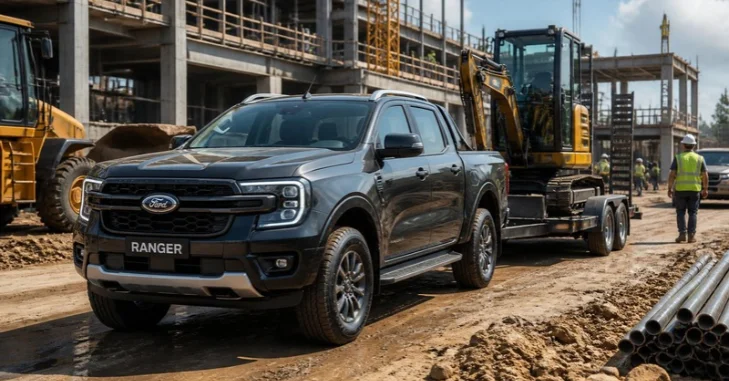
The 2.3-liter EcoBoost four-cylinder can achieve the full 7,500-pound rating in both 4×2 and 4×4 configurations. Ford lists a 12,370-pound GCWR for the 4×2 configuration. The corresponding 4×4 configuration increases GCWR to 12,590 pounds.
The Ford Ranger Towing Capacity remains at 7,500 pounds with the available 2.7-liter EcoBoost V6 when properly equipped in a 4×4 configuration. Although the engine does not increase the maximum trailer rating, its GCWR rises to 12,745 pounds, giving the powertrain a different operating envelope.
The 3.0-liter EcoBoost V6 belongs to the performance-focused Raptor. That model has a published maximum loaded trailer weight of 5,510 pounds. Its 11,465-pound GCWR is also lower than the conventional configurations listed above.
This comparison shows why engine output alone cannot determine towing capability. The truck’s chassis, suspension, axle, cooling, tires, and factory configuration also affect its certification. Buyers should therefore compare the complete vehicle specification instead of horsepower alone.
Why Does the Ranger Raptor Tow Less?
The Raptor makes more power than the conventional versions, but it is designed around high-performance off-road driving. Its suspension geometry, specialized hardware, tires, and overall configuration serve a different purpose. Those engineering priorities help explain why its trailer rating stops at 5,510 pounds.
This distinction matters for buyers choosing between trail performance and maximum towing. A more powerful engine does not automatically produce a higher tow rating. The complete vehicle must handle acceleration, braking, stability, heat, and structural loads safely.
Drivers focused primarily on trailers may find a properly equipped XL, XLT, or Lariat more suitable. Drivers focused on fast off-road use may value the Raptor’s specialized chassis instead. Readoura’s hybrid truck guide offers another useful comparison for shoppers evaluating pickup capability and efficiency.
What Equipment Do You Need to Tow 7,500 Pounds?
Ford’s 2026 order information lists the Trailer Tow Package as optional on XL, XLT, and Lariat. The package includes a Class IV trailer hitch receiver and a four-pin/seven-pin wiring harness. Ford identifies this package as the equipment needed for towing up to 7,500 pounds.
An Advanced Towing Package is also available on XLT and Lariat models. It adds a trailer brake controller and Pro Trailer Backup Assist. Ford also offers a package combining those features with additional driver-assistance technology.
The factory towing hardware matters because Ford limits towing from the rear step bumper to 3,500 pounds. The bumper also carries a maximum tongue load of 350 pounds. The proper hitch receiver raises those published limits substantially.
Before connecting a trailer, inspect the hitch, ball mount, safety chains, wiring, and trailer brakes. Readoura’s guide to car parts and towing equipment covers several components commonly involved in trailer transport. Matching every component to the intended load helps avoid creating a weak point.
Maximum Rating vs. the Weight You Can Really Tow
The 7,500-pound figure is a maximum rating for a properly equipped configuration. It is not permission to load every truck and trailer combination to that figure. Ford states that towing capability varies with cargo, passengers, accessories, and vehicle configuration.
Payload is one of the most important limits to watch. Ford lists up to 1,767 pounds of available payload for applicable 2026 configurations. The number for your individual truck appears on its certification and tire-loading labels.
Trailer tongue weight uses part of that available payload. Passengers, tools, luggage, bed cargo, and dealer-installed accessories use it too. A truck can therefore reach its payload limit before reaching the advertised maximum trailer weight.
Consider a Ranger carrying four adults, camping supplies, and several hundred pounds of tongue weight. Those loads all count against the truck’s available carrying capacity. Checking only trailer weight would miss a large part of the safety calculation.
Understanding GCWR, Payload, and Tongue Weight
Gross Combined Weight Rating, or GCWR, limits the combined loaded weight of the truck and trailer. Ford publishes different GCWR figures depending on engine and drivetrain. Your combination must remain within that value even when the trailer itself is under its individual limit.
Payload measures how much weight the truck can carry rather than pull. It includes people, cargo, equipment, and trailer tongue weight pressing on the hitch. Heavier cabin or bed loads leave less available capacity for tongue weight.
Tongue weight is the downward force the trailer places on the hitch. Too little can contribute to trailer instability, while excessive weight can overload the truck. Always follow the trailer manufacturer’s loading instructions and the ratings attached to your particular vehicle.
Owners who frequently research trucks can browse Readoura’s Automobile section for related pickup, vehicle, and ownership coverage. Comparing specifications across vehicles becomes easier once these weight terms are familiar. They also help separate advertised maximums from practical loaded limits.
Can a Ranger Tow a Camper, Boat, or Car Trailer?
Many travel trailers, fishing boats, utility trailers, and smaller car-hauling combinations can fall within the Ranger’s published limits. The determining number is the trailer’s loaded weight, not its empty advertising weight. Water, fuel, batteries, gear, vehicles, and other cargo can add substantial weight.
A camper listed at 5,500 pounds empty might weigh much more after loading for a trip. That difference reduces the remaining margin below the truck’s maximum rating. Buyers should compare the expected loaded trailer weight with their exact truck’s ratings.
The same rule applies to boat trailers and vehicle transport. Add the boat or vehicle, trailer, fuel, equipment, and cargo before evaluating the combination. Never assume a trailer is suitable because its empty weight fits comfortably below 7,500 pounds.
Is the 2.7L V6 Better for Towing Than the 2.3L?
Both engines can reach the same 7,500-pound published maximum in appropriate configurations. The larger V6 therefore does not raise the top trailer rating. Its advantage comes from producing stronger engine output rather than increasing the certified maximum.
That extra performance may feel useful during acceleration, merging, or climbing grades with a loaded trailer. It does not change the truck’s legal or manufacturer-specified weight limits. Buyers should choose the engine based on broader driving needs instead of assuming the V6 increases capacity.
For occasional towing, the 2.3-liter model can still provide the full published rating with the correct equipment. Frequent towing may make the V6’s additional power more appealing to some drivers. Either way, the exact door-label limits and Ford towing information remain controlling.
How to Check Your Ranger Before Towing
Start by identifying the exact model year, engine, drivetrain, and installed towing equipment. Then check the certification labels on the truck for payload and other vehicle-specific limits. Compare those values against the planned passenger, cargo, and trailer loads.
Next, confirm the trailer’s loaded weight rather than relying only on its dry weight. Include equipment, water, fuel, luggage, tools, and anything else carried inside it. Verify that the hitch, ball mount, coupler, safety chains, electrical connector, and brakes match the load.
Finally, calculate your remaining payload after accounting for occupants and cargo. Leave sensible capacity for the trailer’s tongue load rather than loading every rating to its ceiling. If any number is uncertain, verify it through Ford documentation or a qualified towing professional.
Frequently Asked Questions
What is the Ford Ranger towing capacity for 2026?
Properly equipped 2026 XL, XLT, and Lariat models can tow up to 7,500 pounds. The Ranger Raptor is rated for up to 5,510 pounds. Actual capability varies with configuration, passengers, cargo, accessories, and installed towing equipment.
Does the 2026 Ranger need a tow package?
The highest rating requires Ford’s available Trailer Tow Package on XL, XLT, and Lariat. That package includes the necessary hitch receiver and trailer wiring. Raptor includes its towing equipment as standard.
Can the Ranger tow 7,500 pounds from the bumper?
No, Ford limits towing from the rear step bumper to 3,500 pounds. The published bumper tongue-load limit is 350 pounds. Reaching the higher trailer rating requires the proper hitch receiver and towing equipment.
Does the Ranger Raptor tow more because it has more power?
No, the Raptor’s maximum trailer rating is 5,510 pounds. Its design prioritizes specialized off-road performance rather than maximum conventional towing. Vehicle-level engineering determines the rating, not engine power by itself.
How do I know my exact towing limit?
Check the owner’s information, towing guide, equipment, and labels for your individual truck. Then account for passengers, bed cargo, accessories, and trailer tongue weight. Your real operating limit is the lowest applicable rating in that combination.
The Bottom Line
The Ranger offers strong midsize-pickup capability when it is configured correctly. Conventional 2026 models can reach 7,500 pounds, while the Raptor is rated for 5,510 pounds. Bumper-only towing remains limited to 3,500 pounds.
The advertised maximum should be treated as a ceiling rather than a target. Payload, GCWR, tongue weight, passengers, equipment, and trailer loading all matter before departure. Checking each number gives you a more useful answer than relying on a single brochure figure.
Before towing, confirm the ratings for your exact truck and weigh the loaded trailer when practical. Use the correct hitch equipment and stay below every applicable limit. That approach protects both capability and safety when putting the Ranger to work.